Workshop detalis

Embedded Systems & VLSI

Workshop:5Days
Engineering: CSE/ECE/IT
Enrolled: 60 students
(30 Reviews)

Very-large-scale integration (VLSI) is the process of creating an integrated circuit (IC) by combining hundreds of thousands of transistors or devices into a single chip. VLSI began in the 1970s when complex semiconductor and communication technologies were being developed

The microprocessor is a VLSI device. This Workshop majorly focus on VLSI Design. VLSI and Embedded Systems Design Techniques are the main pillar of most of the present research, industrial and commercial activities in Electronics Engineering

Course description

Very-large-scale integration (VLSI) is the process of creating an integrated circuit (IC) by combining hundreds of thousands of transistors or devices into a single chip. VLSI began in the 1970s when complex semiconductor and communication technologies were being developed. The microprocessor is a VLSI device. This Workshop majorly focus on VLSI Design. VLSI and Embedded Systems Design Techniques are the main pillar of most of the present research, industrial and commercial activities in Electronics Engineering. This training program focuses on specific design techniques using VLSI Design Tools & Software. It also focuses on embedded system techniques such as Microcontroller Programming..

What you'll learn from this course
  • Ready to begin working on real-world data modeling projects.
  • Expanded responsibilities as part of an existing role.
  • Manage your time so you'll get more done in less time.
  • Hone sharp leadership skills to manage your team.
  • Cut expenses without sacrificing quality.
Certification

At TechIn IT, we proudly assure that every Trainee who successfully completes our program will be awarded a certificate. We are officially associated with APSCHE, AICTE, MSME, Skill India, IAF, and NASSCOM. The certification will reflect the Trainees dedication and skill development, recognized under national-level standards .

  • Introduction Of Embedded System

    What is Embedded Systems

    Microcontrollers, Microprocessors

    Difference b/w Microcontrollers & Microprocessors

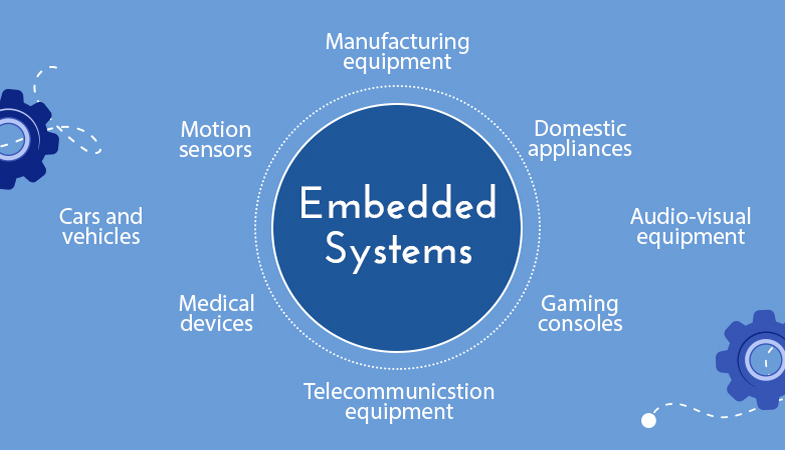
    Applications of Embedded Systems

    Introduction Embedded C

    Difference b/w Embedded C and C

    Benefits of C over Assembly language

    Data type and its memory representation

    Arrays

    Operators

    Bit Operators

    Control statements,loops

    Embedded Programming and Interfacing Peripherals AVR series Microcontrollers

    Introduction of AVR

    Features and architecture of AVR

    Input /output port

    Memory organisation

    Led blinking Programming concept

    Glowing LEDs in a pattern of your choice

    Controlling Relay by microcontroller

    Intro to LCD

    Interfacing sensor

    Intefacing Motors

    Introduction to VLSI

    Introduction to SSI,LSI,VLSI

    Introduction of Discreet Component and IC.

    Electronics Design Advantage of IC

    Why VLSI?

    why silicon?

    Fabrication Step

  • Adders

    Subtractor

    Mux/Demux

    Encoder/Decoder

    Parity checker/generator

    Sequential Logic Circuit

    Flip Flops

    Latchs

    Counters

    Register

    Introduction to HDL's(VHDL/VERILOG)

    Introduction of HDL

    Why HDL

    Design Methodologies

    Introduction to VHDL

    Data Types VHDL Design Flow

    VHDL Syntax – Some General Rules

    The Standardization of VHDL

    Libraries and Packages

    ENTITY

    Architecture Body(functionality of entity)

    MODELLING

    STRUCTURAL

    DATAFLOW

    BEHAVIORAL

    MIXED

    Data Objects

    Signals

    Variables

    Constant

    AND ,OR ,NOR,XOR,NOT Gate

  • HALF Adder

    FULL Adder

    Half Subtractor

    Full subtractor

    Encoder

    MUX

    Decoder

    D Flip Flop

    T Flip Flop

    JK Flip Flop

    Up counter

    Down counter

    Up and down counter

    Ripple counter

    Ring counter

    Shift Register

Scroll